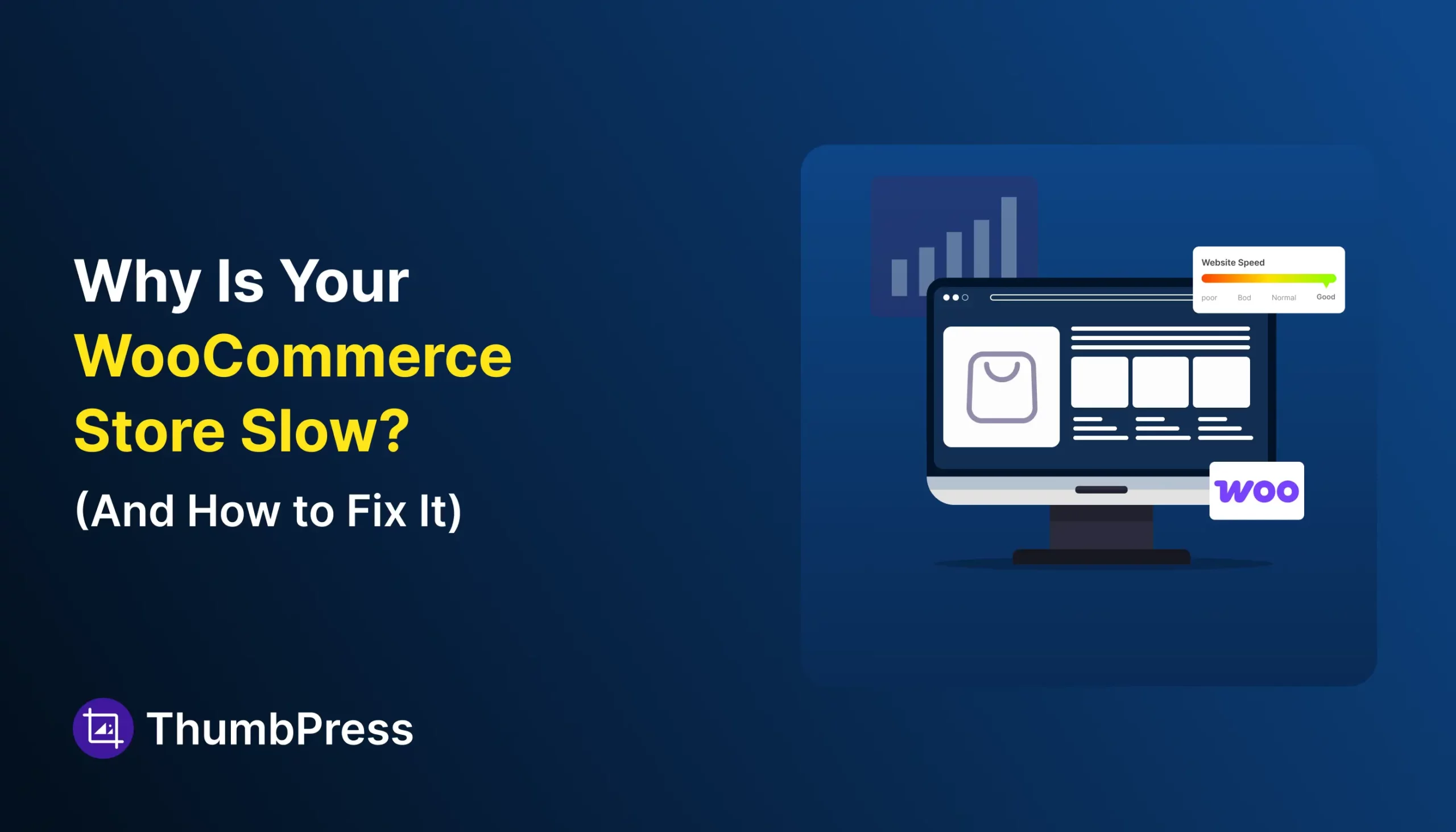
Why Is Your WooCommerce Store Slow? (And How to Fix It)


Every second your WooCommerce store takes to load costs you money. A one-second delay in page load time can drop your conversion rate by 7%, that’s not just a statistic, that’s real revenue. For a store doing $10,000 monthly, that’s $700 in lost annual sales from a single second of lag.
The real problem is different. Your WooCommerce store doesn’t slow down from one thing. It slows down due to accumulated friction, unoptimized product images hogging bandwidth, 30+ plugins each loading their own JavaScript, a database swollen with years of orders, and a bloated theme running unnecessary animations. Each problem adds milliseconds. Milliseconds become seconds. Seconds become cart abandonment.
This guide covers the seven actual reasons why WooCommerce stores slow down, what makes each one worth fixing, and how to fix it without hiring anyone.
The Real Cost of a Slow WooCommerce Store
Before we delve into solutions, let’s discuss what slow actually costs you.
How Speed Impacts Your Bottom Line
You already know people hate waiting. What might surprise you is how fast they leave.
Over half of mobile users, 53% by Google’s count, abandon a site after three seconds. Think about what that means for your ad spend. You’re paying for traffic that never even sees your store.
Then there’s the conversion hit. The average WooCommerce store converts about 2.3% of visitors. But when your store slows down, that percentage tanks. Hard. A single second of lag doesn’t just frustrate people, it directly cuts your revenue.
WooCommerce powers over 6 million stores, generating $30+ billion yearly. The fastest stores? They’re converting at 3%+, not 2%. That gap is almost entirely speed-related.
Why Core Web Vitals Matter More Than Overall Load Time
Google stopped caring about raw load times. Now they measure three specific things: how fast your biggest content appears (Largest Contentful Paint), whether your page responds when clicked (Interaction to Next Paint), and whether elements stay put while loading (Cumulative Layout Shift).
These are Core Web Vitals. They rank your site. Fail them, and you lose visibility.
But honestly? What matters more is that Core Web Vitals measure what your customers actually feel. A page can technically load fast but still feel slow if your hero image takes ages to appear, or if buttons jump around while you’re clicking. Optimizing for Core Web Vitals means optimizing for actual human experience and that’s what recovers both rankings and revenue.
Quick Performance Self-Audit (Free Tools)
Before you start fixing anything, measure where you actually are. Use Google PageSpeed Insights (pagespeed.web.dev) – it’s free and gives you Core Web Vitals scores for mobile and desktop. Write down your current LCP, INP, and CLS scores.
You’ll also see specific recommendations. Most store owners ignore these recommendations because they sound technical. Don’t. They’re usually pointing at the real bottlenecks.
Cause #1: Unoptimized Product Images (The Biggest Culprit)
Images are the single biggest reason WooCommerce stores slow down. It’s not even close.
On a typical ecommerce site, images consume 40–60% of total page weight. Uncompressed product photos, hero banners, thumbnails – they all load, and every kilobyte has to travel from your server to your customer’s device. On mobile or slower networks, this isn’t subtle. It’s noticeable waiting.
Imagine a product page with five unoptimized images. You might be serving an extra 2–3 megabytes per visitor. Multiply that by thousands of daily shoppers. Now you’ve got a real performance problem.
Why Images Are Killing Your Speed
Most WordPress store owners upload images at full resolution-3000+ pixels wide, sometimes several megabytes each. They assume WordPress will handle resizing. It does, but only after the original giant file is already downloaded.
If you’re not deliberately optimizing images, you’re serving oversized files in outdated formats. JPEGs from five years ago. PNGs that could be 60% smaller. No compression. No modern formats.
The result: your Largest Contentful Paint (LCP), the metric that measures how fast the main content appears, suffers. Google sees your store as slow. Your customers experience slow. And your conversion rate reflects it.
Image Optimization Strategies (Compression, Resizing, WebP)
There are three things you need to do:
1. Compress all existing images. You can reduce file sizes by 50–70% without visible quality loss using compression tools. Tools like TinyPNG, ImageOptim, or dedicated WordPress plugins can handle bulk compression, reducing file size from 2MB to 400KB with no visible difference to your customers.
2. Convert to modern formats. The WebP format is roughly 34% smaller than traditional JPEG and PNG while maintaining equivalent visual quality. A featured image that’s 800KB as a JPEG becomes roughly 520KB as WebP. On a page with 10 product images, that’s real savings.
To learn the best practices for converting your library, check out our detailed WebP conversion guide, which walks through safe methods and browser compatibility.
3. Resize images before uploading. A product photo doesn’t need to be 3000 pixels wide. Your product pages are probably 1200 pixels at most. Resize to fit your template before uploading, and you cut file size before it ever enters your media library.
How to Implement in WordPress Without Breaking Quality
The right approach is to optimize existing images first, then set up automation for new uploads.
Start with a thorough audit. Use our image optimization guide to understand what needs fixing, then tackle old images systematically. A bulk optimization tool can handle hundreds at once.
For new uploads, enable automatic compression on upload and set it to a reasonable quality level (80-85% is the sweet spot-visually identical to the human eye, file size much smaller). This way, every new product photo is optimized the moment it enters your library.
Then enable lazy loading. This delays loading of images until a visitor scrolls near them, which speeds up initial page render time. Your above-the-fold content loads first; product thumbnails further down the page load only when needed.
Cause #2: Too Many Plugins and Third-Party Scripts

Plugins are the double-edged sword of WordPress. They add functionality. They also add weight.
Every plugin loads code. Usually on every page. Sometimes it’s harmless. But when you run 20+ plugins, something interesting happens: they compound. One adds JavaScript, another adds styles, another makes database queries. Individually fine. Together? Noticeable.
The real killer is plugins running during checkout. Discount engines, abandoned-cart trackers, live chat, analytics tags, review systems-all loading scripts while your customer is trying to buy. On a slow connection, this becomes lag.
Which Plugins Slow Down Checkout
Not all plugins are equally problematic. Some are lightweight. Others load heavy JavaScript libraries that block page rendering.
The worst offenders tend to be:
- Multi-purpose all-in-one plugins that include features you don’t use
- Heavy page builders that load scripts everywhere, even on pages where you’re not using them
- Third-party integrations (CRM connectors, marketing automation, chat tools) that run real-time API calls during checkout
- Analytics and tracking tools that load their own JavaScript libraries
Start by auditing what you actually have. Go to your Plugins page and ask: do I use this? If the answer is “not really” or “maybe,” deactivate it. Test your store. If nothing breaks, delete it.
How to Audit and Disable Non-Essential Scripts
Use a plugin like Asset Cleanup or Perfmatters to see exactly which scripts load on each page. You’ll often find that plugins are loading code on pages where it’s not needed.
For example, your page builder might load on every single page, but you only use it on five pages. Perfmatters lets you disable it everywhere else. That’s an instant win.
For checkout specifically, disable every script that isn’t essential. Your payment gateway and shipping calculator must load. Your live chat widget probably doesn’t need to. Neither does your exit-intent popup.
Plugin Alternatives (Consolidation Strategies)
If you’re running multiple plugins that serve overlapping functions, say, two discount plugins, or three analytics trackers, consolidate. Pick the best one in each category and remove the rest.
Sometimes lightweight alternatives exist. If you’re running a heavy all-in-one SEO plugin just for sitemaps, you could replace it with a minimal SEO plugin and handle sitemaps separately.
Every plugin you remove is one less thing slowing down your store.
Cause #3: Poor Hosting or Server Infrastructure
This is where everyone points fingers first, and it’s worth checking.
Bad hosting shows up in your Time to First Byte (TTFB), the gap between when someone requests your page and your server responds. If this is over 600ms, hosting is your problem. Under 300ms? Hosting is probably fine.
Check yours in PageSpeed Insights. If TTFB is high and you’ve trimmed your images, disabled plugins, and cleaned your database, then it’s time to move.

Signs Your Hosting Is Underpowered
Cheap shared hosting is fine for a blog. WooCommerce? It needs more. Real signs your host is inadequate:
- High TTFB no matter what plugins you kill
- Crashes during traffic spikes (promotions, holiday sales)
- Slow order processing (databases taking forever)
- Zero resource scaling (stuck on the same plan)
Shared hosting companies oversell hard. You might be on a server with 200 other sites competing for the same resources. During peak hours, your store loses.
Cloud Hosting vs. Shared Hosting for WooCommerce
Cloud hosting works differently. Instead of one physical server shared with hundreds of sites, you get resources that scale with your traffic. When you have a traffic spike, your site automatically uses more resources. When traffic drops, you use less.
Good managed WordPress hosts (Kinsta, WP Engine, Cloudways) include built-in performance optimizations, automatic backups, and performance monitoring. They cost more upfront, but they handle the complexity.
If you’re on shared hosting and your store is growing, cloud hosting usually pays for itself within a few months through improved conversions alone.
When to Switch (and How to Migrate Safely)
Pick a new host. Most good ones offer free professional migration. They’ll move your site, set up your DNS, and handle the technical details. The whole process usually takes a day or two.
Before you switch, take a backup of your current site. Keep your old hosting active for 48 hours after the migration in case anything goes wrong. Then you can go back.
Cause #4: Heavy Theme or Design Bloat
Your theme defines more than just how your store looks. It defines how fast it loads.
Some modern themes come packed with sliders, animations, dynamic blocks, and dozens of JavaScript enhancements. They load on every page, including checkout, even if you’re not using them. A feature-rich theme can turn a fast default WordPress install into something noticeably sluggish.
How to Identify a Slow Theme
Use Pingdom or GTmetrix and filter results by “themes.” You’ll see all the files your theme is loading and how large they are. Long yellow bars in the waterfall chart indicate slow load times.
If your theme files are taking several seconds to load, or if you see large CSS/JavaScript files you’re not using, the theme is probably part of your problem.
Lightweight Theme Alternatives
Not all themes are equal. Some are built specifically for performance—minimal code, no unnecessary scripts, focus on speed. Genesis, StudioPress, and some purpose-built ecommerce themes prioritize this.
If you’re on a heavy theme that you love, you might be able to trim the fat. Disable unnecessary features in theme settings. Remove sliders and animations from pages where they’re not needed. Some theme developers let you choose which features to load.
Code Minification and Asset Removal Quick Wins
Minification removes unnecessary characters from your CSS and JavaScript, reducing file size by 20–30% without changing functionality. Most caching plugins do this automatically.
You can also selectively disable theme features. Some themes have toggles for “enable animations,” “load custom fonts,” etc. If you’re not using them, turn them off.
Cause #5: External Payment and Shipping Gateways (API Delays)
When a customer enters their payment information and hits “Place Order,” your store makes real-time API calls to payment gateways, shipping providers, and tax calculators.
If any of these services are slow, your customer sees a spinning loader. They wait. They second-guess their purchase.
How Payment API Lag Affects Checkout Experience
Every millisecond of latency at checkout matters. Studies show that even small delays increase abandonment. When customers have to wait more than a few seconds for a button to respond or a shipping rate to calculate, they bail.
The problem isn’t usually your code. It’s the responsiveness of external services. Stripe’s performance is different from PayPal’s. One shipping calculator might respond in 200ms; another in 2 seconds.
Testing and Monitoring Third-Party Performance
Check your logs. Use your browser’s Network tab during a test purchase. Watch how long each external API call takes. Identify which ones are slowest.
If one consistently takes 2+ seconds, you might consider an alternative. Stripe and Braintree generally have strong response times. Shipping providers vary widely—USPS integration might be faster than FedEx in your region.
Caching and Request Optimization Techniques
Cache shipping rates when possible. If a customer requests the same zip code twice, don’t query the API again – serve the cached result. Some shipping plugins support this. If yours doesn’t, ask if there’s a more optimized alternative.
Consider limiting the number of payment options. Every extra gateway option is another potential API call. Keep just the ones your customers actually use.
Cause #6: Bloated Database and Old Orders
WooCommerce stores accumulate garbage. Orders from three years ago. Failed transaction logs. Abandoned sessions. Plugin data from extensions you deleted – all still taking up space in your database.
Over time, this bloat kills query performance. Simple operations take longer because your database has to sift through millions of old records to find what it needs.
It’s especially noticeable at checkout. WooCommerce needs to calculate totals, apply discounts, fetch customer data—and it needs to do it fast. A bloated database adds latency that your customers actually feel.
Why Accumulated Order Data Slows Everything Down
Every query your database processes consumes resources. When you’re running 500,000+ orders with all their associated metadata, routine operations slow down noticeably. That’s not theoretical. That’s your checkout taking three seconds instead of one.
Database Cleanup and Archiving Strategies
Start with cleanup. Remove:
- Spam comments
- Old post revisions (keep only the last few)
- Expired transients
- Abandoned sessions
- Failed orders you don’t need
Tools like WP-Optimize can automate this. Run a cleanup, then schedule monthly maintenance.
For long-running stores, the better long-term solution is archiving. Move completed orders older than 6–12 months to a separate archive. These orders are still accessible to customers in their account, but they’re out of your hot database. This can improve performance by 20–40% for high-volume stores.
Automated Maintenance for Long-Term Performance
Set up automated database maintenance. Schedule it for off-peak hours (late night or early morning). Keep it regular-monthly at minimum.
Monitor your database size over time. If it’s growing faster than your order volume, something is accumulating unnecessarily. Investigate and clean.
Cause #7: Unoptimized Mobile Experience and Checkout Complexity
Mobile sales account for nearly 45% of WooCommerce transactions. Yet many stores optimize for desktop first and squeeze the checkout onto mobile as an afterthought.
Mobile slowness isn’t always about raw load time. It’s often about friction. Long forms with required fields that don’t apply to all customers. Buttons that require zooming. Text that’s too small.
Mobile Performance Issues (Forms, Fields, Layout)
Test your checkout on mobile. Open it in your phone’s browser. Try to complete a purchase.
Where does it feel slow? Is there unnecessary scrolling? Do you have fields that most customers don’t need? Are buttons and form fields touch-friendly (at least 44×44 pixels)?
Mobile networks are slower than desktop broadband. A page that feels fast on your office WiFi might feel glacial on a 4G connection. Mobile-specific optimization matters.
Simplifying Your Checkout Flow
Every field you ask for is a friction point. Ask only for what you need to take payment and fulfill the order: name, email, address, phone (if needed for delivery), payment details. Nothing else.
Hide optional fields behind a checkbox. “Need to add special instructions?” Customers who need it will click. Others won’t see unnecessary fields.
Use auto-fill and smart defaults. Pre-select the customer’s country if you know it. Pre-populate state/province based on zip code if possible.
Mobile-Specific Core Web Vitals Testing
Use PageSpeed Insights specifically for mobile. Your desktop scores might be fine while mobile scores are poor. Mobile gets different handling for network speed and device performance.
Focus on Largest Contentful Paint (LCP) on mobile. It’s often slower than desktop because the network is slower and processing power is less.
Fix Them Together: A Performance Checklist
You don’t have to fix everything at once. Prioritize by impact.
Today (30 minutes):
- Run PageSpeed Insights and note your current scores
- Audit and deactivate unused plugins
- Disable unnecessary plugins on checkout page
- Clean up your database (spam, revisions, sessions)
This Week:
- Compress existing product images
- Set up automatic compression on new uploads
- Enable lazy loading
- Test your checkout on mobile and simplify if needed
- Check your TTFB and hosting performance
This Month:
- Convert images to WebP format
- Implement a caching solution if you don’t have one
- Monitor and optimize third-party script performance
- If TTFB is high, explore better hosting options
- Archive old orders if you have 5+ years of data
Each of these moves the needle. Together, they can cut your load time in half.
Conclusion
A slow WooCommerce store doesn’t fail for one reason. It fails because small inefficiencies pile up-a heavy theme, unoptimized images, too many plugins, database bloat, poor hosting.
The good news? You don’t need to rebuild everything. Start with the quick wins: compress and optimize your product images, audit and remove unnecessary plugins, clean up your database. These three moves alone might cut your load time in half.
Then move on to the structural improvements: better hosting if needed, a lighter theme, proper caching. Each step compounds.
The fastest stores don’t get there by luck. They get there by treating performance like a system—identifying bottlenecks, removing waste, and maintaining the basics. Your conversion rate, your search rankings, and your customers’ experience all depend on it.
Start today. Measure, fix, test, repeat. Your bottom line will thank you.
Frequently Asked Questions
How much speed improvement will I see after optimization?
It depends on where you’re starting. A store with uncompressed images and 30 active plugins might see 50–60% load time improvement from basic optimization. A store that’s already fairly optimized might see 15–20%. Either way, the improvement shows up in your conversion rate.
Do I need to hire a developer for these fixes?
Most of these fixes don’t require a developer. Image compression, plugin auditing, database cleanup, caching setup—all doable for a store owner with a little patience. The only things that might require help are custom code changes or a hosting migration if something goes wrong.
What’s the fastest way to improve my conversion rate through speed?
Start with images. They account for most of the weight on ecommerce sites, and optimization has an immediate, visible impact. Our detailed image optimization guide walks through the whole process. After images, audit plugins. Those two fixes often account for 60–70% of the improvement you’ll see.
Can image optimization alone fix a slow WooCommerce store?
It depends. If unoptimized images are your main problem, yes. But if you also have 50 active plugins and a bloated database, images are just one part of the solution. That said, image optimization usually delivers the fastest ROI because it’s quick to implement and has a noticeable impact.
Subscribe to Our Newsletter
Get the latest WordPress tutorials, trends, and resources right in your inbox. No Spamming, Unsubscribe Anytime.

Thank you for subscribing to our newsletter!


Table of Content
- The Real Cost of a Slow WooCommerce Store
- How Speed Impacts Your Bottom Line
- Why Core Web Vitals Matter More Than Overall Load Time
- Quick Performance Self-Audit (Free Tools)
- Cause #1: Unoptimized Product Images (The Biggest Culprit)
- Why Images Are Killing Your Speed
- Image Optimization Strategies (Compression, Resizing, WebP)
- How to Implement in WordPress Without Breaking Quality
- Cause #2: Too Many Plugins and Third-Party Scripts
- Which Plugins Slow Down Checkout
- How to Audit and Disable Non-Essential Scripts
- Plugin Alternatives (Consolidation Strategies)
- Cause #3: Poor Hosting or Server Infrastructure
- Signs Your Hosting Is Underpowered
- Cloud Hosting vs. Shared Hosting for WooCommerce
- When to Switch (and How to Migrate Safely)
- Cause #4: Heavy Theme or Design Bloat
- How to Identify a Slow Theme
- Lightweight Theme Alternatives
- Code Minification and Asset Removal Quick Wins
- Cause #5: External Payment and Shipping Gateways (API Delays)
- How Payment API Lag Affects Checkout Experience
- Testing and Monitoring Third-Party Performance
- Caching and Request Optimization Techniques
- Cause #6: Bloated Database and Old Orders
- Why Accumulated Order Data Slows Everything Down
- Database Cleanup and Archiving Strategies
- Automated Maintenance for Long-Term Performance
- Cause #7: Unoptimized Mobile Experience and Checkout Complexity
- Mobile Performance Issues (Forms, Fields, Layout)
- Simplifying Your Checkout Flow
- Mobile-Specific Core Web Vitals Testing
- Fix Them Together: A Performance Checklist
- Conclusion
- Frequently Asked Questions
- How much speed improvement will I see after optimization?
- Do I need to hire a developer for these fixes?
- What's the fastest way to improve my conversion rate through speed?
- Can image optimization alone fix a slow WooCommerce store?